GHOSTBUSTERS
WHO YOU GONNA CALL? DAVID CRANE — THE MAN HAD SERIOUS TALENT
► BLAME IT ALL ON A WOMAN IN A LIBRARY
This is one of those games that stayed stuck in my mind — not just because of the game itself, but because of the film. I still remember going to see it at the cinema. It was a summer open-air cinema in a small coastal town, the kind with plastic chairs and a screen under the stars where mosquitoes were practically part of the ticket price. I went with my older brother, him nine and me six. It was supposed to be a comedy, and we started watching it that way — Bill Murray clowning around, the three leads looking more hapless than scary — right up until the library scene.
That woman quietly reading her book. The silence. The face when she turned round. She gave me the fright of my life when she transformed into a ghost and chased Ray, Peter and Egon through the corridors. I think I had nightmares about it for several nights afterwards. You're six years old, you watch a woman turn into a monster, and you can say goodbye to a decent night's sleep until the following summer. So when the game appeared on the C64 a year later, I couldn't be indifferent. It was the film. The film that had ruined my sleep.
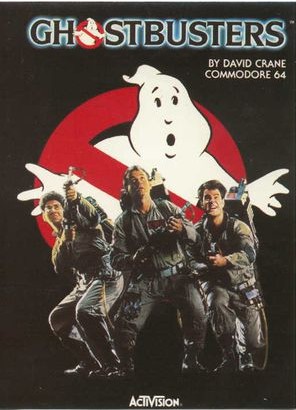
Trivia: David Crane programmed Ghostbusters in just five weeks. Activision had the licence, had the release date, and had its best programmer with his back against the wall. The result sold over a million copies in the first year alone. Not bad for five weeks' work and a few nights of caffeine and code.
► DAVID CRANE AND THE ART OF MAKING MAGIC UNDER PRESSURE
David Crane was, in 1984, one of the most respected programmers in the industry. He had created Pitfall! for Activision — one of the best-selling games in the history of the Atari 2600 — and had that particular gift of the great programmers of the era: making code do things the hardware had no business doing. When Activision secured the licence for Ivan Reitman's film, Crane was the logical choice to bring it to the C64.
The challenge was enormous: how do you turn a ghost-catching film into a video game that isn't rubbish? Many licences of the 80s were exactly that — rubbish with the film's name slapped on top. Crane solved it elegantly: instead of recreating the film scene by scene, he captured the essence of what it meant to be a Ghostbuster. Set up a business, buy equipment, head out in the Ecto-1, catch ghosts, make money. And at the end, face Gozer at Dana Barrett's building.
The game was originally designed for the Atari 800, but the C64 version — adapted within Activision's own team — took advantage of the SID chip to give it a sonic dimension that no other platform could match. And that, friends, made all the difference.
► THE INTRO THAT BLEW YOUR MIND
Before touching the joystick, before spending a single dollar on equipment, something happened that in 1984 was literally unheard of: the game shouted at you. The moment it loaded, your C64's speakers fired out a "GHOSTBUSTERS!" at full volume — a digitised voice, something almost no game was doing — and the Ray Parker Jr. melody kicked in, converted to SID chip. Not with full fidelity, of course, but recognisable. Perfectly recognisable. And in that moment, if you'd seen the film, you got goosebumps.
That was David Crane understanding something many developers didn't: the licence isn't the characters or the logo, the licence is the emotion. And the emotion of Ghostbusters started with that song. Full stop.
► THE GEAR, THE CAR AND MANAGING YOUR MONEY
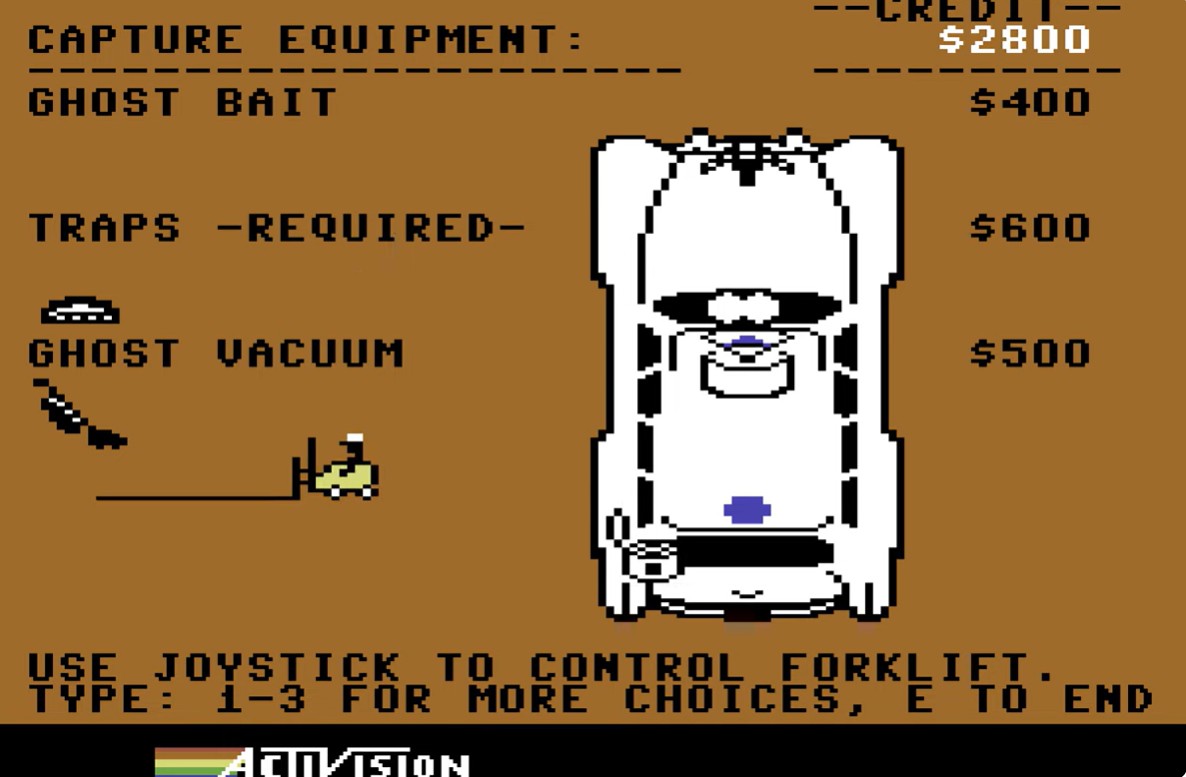
The game opened with an equipment screen that, for a child of the 80s, was pure heaven. You had a limited budget — a bank loan, nothing's free — and you had to choose what to buy for your newly founded business: Ghost Bait, Traps, Ghost Vacuum, PK Energy Detector... each item had its price, and blowing everything on top-tier equipment left you without fuel for the Ecto-1. A lesson in household economics disguised as a video game that no six-year-old understood at the time, but which in hindsight was genuinely sophisticated.
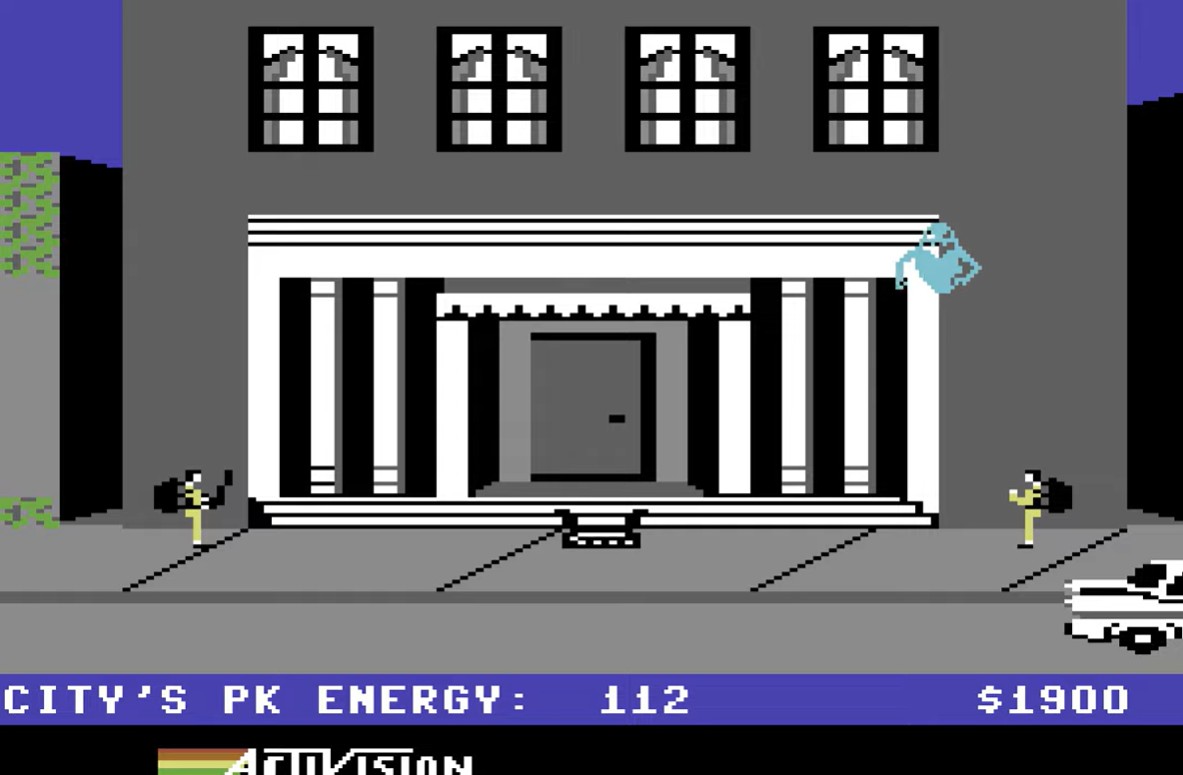
Once kitted out, the main screen showed a city map with ghosts moving through it, steadily raising the city's PK Energy. If that energy hit the maximum... trouble. Very bad trouble. You had to head out in the Ecto-1, reach the infested buildings in time, trap ghosts, collect your fee per capture, and keep yourselves financially afloat. The game had a layer of resource management that very few action titles of the era had dared to include.
► SCREENSHOT GALLERY
📷 More screenshots at Lemon64 and MobyGames (links below)
► THE DRIVING STAGE: THE ECTO-1 IN ALL ITS GLORY
The driving stage was deceptively simple: the Ecto-1 scrolled vertically towards the building, and the ghosts floating along the road got caught when they touched the car's Ghostbusters logo. Simple in theory. Maddening in practice, because the ghosts moved erratically and the traffic was hardly helpful.
But there was something hypnotic about that stage. The Ecto-1 sprite, unmistakable with its design based on the Cadillac from the film, rolling down a road while the music played in the background. It was one of those stages you remembered long after switching off the computer. And one you talked about the next day at school with the friend who also had a C64.
► THE STAY PUFT MARSHMALLOW MAN ALWAYS WON
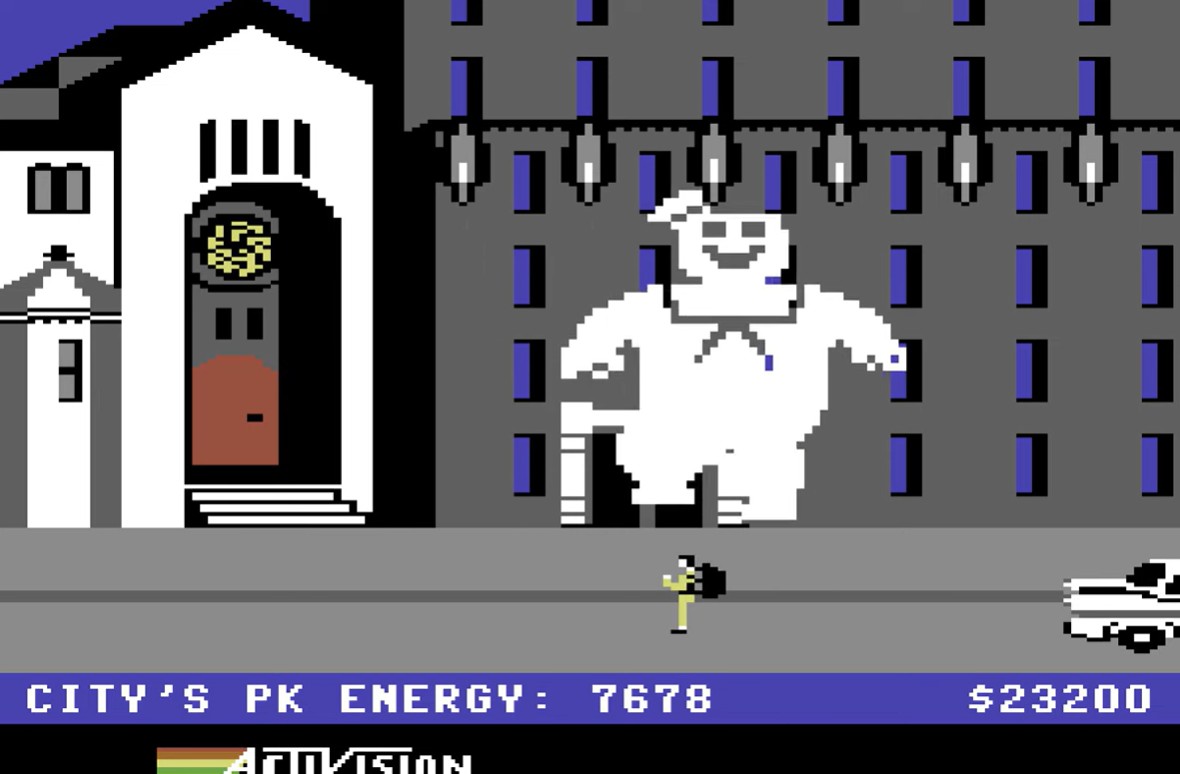
And then there was him. The Stay Puft Marshmallow Man. The giant white puffball who in the film was the form Gozer chose to destroy New York, and who in the game appeared as the final boss when the Ghostbusters tried to enter Dana Barrett's building. That big marshmallow fellow always won.
The stage was chaotic, frantic and fairly merciless with the player. The Stay Puft wandered across the screen with that look of absolute satisfaction while you tried not to die in the attempt. Most of the time, the Stay Puft won. With a grin from ear to ear. As it should be.
In an interview years later, David Crane admitted that he designed the Stay Puft in the game over a weekend and never expected it to become the most-remembered moment of the entire experience. Forty years on, we're still talking about that marshmallow man. You have to take your hat off.
► SOUND: WHEN THE SID SOUNDED LIKE THE CINEMA
Russell Lieblich was responsible for bringing Ray Parker Jr.'s soundtrack to the C64's SID chip, and the result was one of the most memorable moments in 8-bit gaming audio history. It isn't perfect — the SID has its limitations and the original has its full harmonic richness — but it's recognisable in an instant, and in 1984 that was an enormous achievement.
The digitised voice at the start — that "GHOSTBUSTERS!" greeting you every time you loaded the game — was technically impressive for the era. There was nothing like it on the Spectrum. Nothing on the Atari either. It was one of those moments when the C64 puffed out its chest and said: I'm in a different league. And it wasn't wrong.
► A LICENCE THAT RESPECTED WHAT MATTERED
Ghostbusters for C64 was an exception in an era when film licences were almost always a disappointment. Activision had the name, the song, the characters, and instead of making a mediocre game with all that on top, they hired their best programmer and let him do what he knew how to do. The result was a game that captured the spirit of the film — the humour, the chaotic action, the Ecto-1, the Stay Puft — without trying to be a literal recreation of it.
Was it a perfect game? No. The money management could get repetitive, the game was relatively short for a skilled player, and the final stage relied more on luck than ability. But in 1984, with six years just behind you and the library scene still very much present in your memory, it was exactly the game you needed. The one that made you feel like you could be a Ghostbuster too. Even if the Stay Puft beat you nine times out of ten. The other one, you were a god.
Ghostbusters for C64 is one of the great licensed games of the 80s, and probably the best Activision made in that era. David Crane understood that the licence wasn't the logo — it was the emotion: the song, the Ecto-1, the Stay Puft, the digitised voice that greeted you every time you loaded the game. Forty years on, it still deserves to be played, if not for what it is today, then for what it represented then: the moment when film licences could be great games. And a woman in a library still wouldn't let me sleep.
THE BEST
+ Historic digitised voice intro+ SID chip rendition of the film's soundtrack
+ Original resource management layer
+ David Crane at the top of his game
+ The Stay Puft Marshmallow Man
THE WORST
- The final stage relies too much on luck- Can become repetitive over time
- Short for skilled players
- The Stay Puft Marshmallow Man (yes, here too)
- Ghost AI was fairly erratic