GAME OVER
THE MOST CENSORED COVER IN SPANISH SOFTWARE HISTORY
► THE BOX YOU COULDN'T LEAVE ON THE SHELF
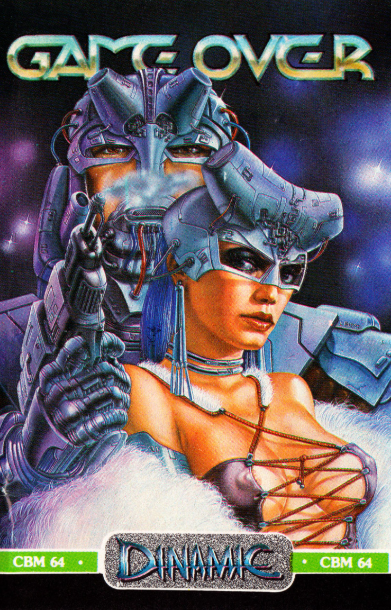
Some games were bought for their gameplay. Others, for their reputation. And then there was Game Over, which many Spanish kids in 1987 bought — or tried to buy — because the box had a girl on it. Not just any girl: a space warrior in metallic armour, blue hair, a strategically cut breastplate and a gaze that said "I'll handle the aliens, you keep quiet". The illustration was by Alfonso Azpiri, the same genius who had signed the Army Moves cover, and once again he had made the box almost more interesting than the game itself.
Dinamic knew it perfectly well. The Madrid-based company had been dominating the Spanish software market for years and understood better than anyone that in that ecosystem of newsagents, flea markets and computer shops, the cover was the marketing. There were no trailers, no influencers, no YouTube reviews. There was a box on a shelf, and you had three seconds to decide whether to hand over your eight hundred pesetas or keep browsing. Azpiri won that battle every time.
Alfonso Azpiri was Dinamic Software's star illustrator during the company's golden years. His style, influenced by American comics and manga, defined the visual identity of an entire generation of Spanish gamers. Army Moves, Game Over, Game Over II... every cover was a poster that many kids tore off the box to pin on their bedroom wall.
► DINAMIC AND THE LEAP INTO SPACE
Following the international success of Army Moves in 1986, Dinamic faced the pressure of their own achievement. They had to match it. They had to surpass it. The answer was to abandon the Vietnamese jungles and military helicopters and head straight into outer space. Game Over told the story of Johanna, an intergalactic warrior who had to rescue her boyfriend — Commander Ken — captured by the evil alien army of planet Hypsis. A plot that in 1987 was more than enough to justify seven planets full of aliens to shoot at.
The game was split into two clearly distinct parts, just like Army Moves. The first was a horizontal scrolling shoot'em up in which you piloted a spaceship across seven planets; the second was a direct action phase in which Johanna, now on foot, blasted her way through enemy installations. Two games in one, double value for the price of one. A sales pitch Dinamic repeated until it became their trademark.
► GAMEPLAY: SHOOT, DIE, REPEAT
The first part of Game Over was a reasonably competent shoot'em up for its time. The ship moved smoothly, enemies had recognisable patterns, power-ups appeared often enough not to lose hope... and then the end-of-level boss arrived and sent you back to the title screen with breathtaking speed. Game Over's difficulty was, like so many Dinamic games, the kind that builds character. Which is to say: brutal, merciless and at times unfair.
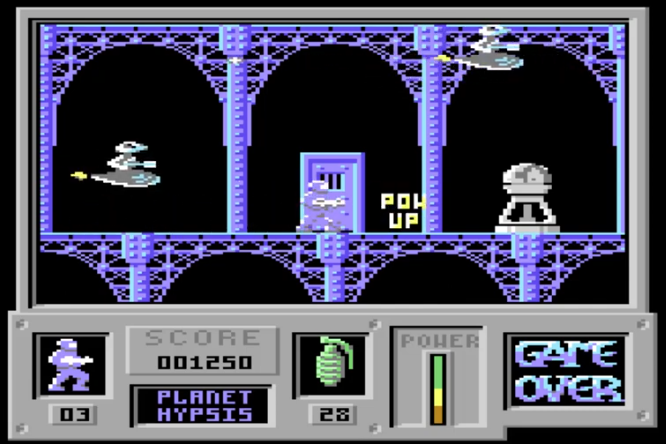
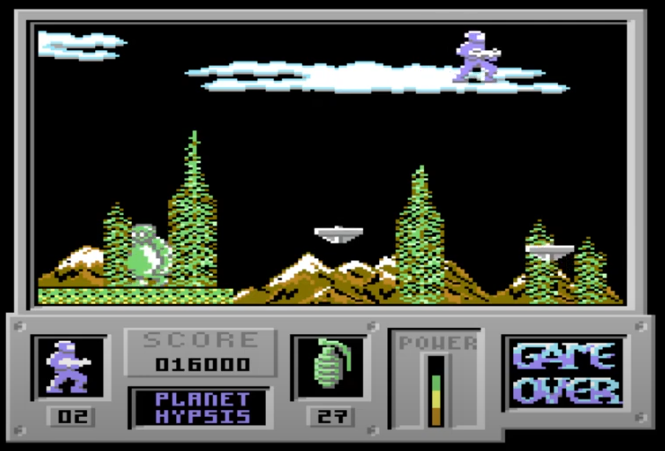
The second part, the action phase with Johanna on foot, was more uneven. The controls were acceptable but the enemy hitboxes had that characteristic imprecision that sometimes meant you died without knowing quite why. The planets had varied designs — from the metallic architecture of Hypsis to the alien forests of Scvunn — but the sense of progression was constantly interrupted by deaths that felt arbitrary. Anyone who actually finished Game Over back in the day deserves a monument.
The planet names in Game Over — Hypsis, Scvunn, and the rest — had that flavour of eighties newsagent science fiction that was utterly irresistible. Nobody knew how to pronounce them. Nobody asked. It was part of the charm.
► GRAPHICS: THE C64 DRESSED TO IMPRESS
Visually, Game Over was one of the most striking games Dinamic had produced up to that point. The first-part stages had a notable chromatic variety: the star-spattered black of Hypsis gave way to the greenish, organic tones of other planets, and each stage had its own set of enemies with recognisable designs and fluid animations. For a C64 in 1987, the result was more than respectable.
The second part lost some of its shine — the stages were more repetitive and the colour palette less varied — but made up for it with well-animated Johanna sprites and enemies with enough visual personality to tell apart. It was no Last Ninja 2, of course. But it never claimed to be: Game Over was a straight action arcade, not a technical showcase, and in that context the graphics more than passed the test.
► SOUND: MARTIN GALWAY DELIVERS
If Azpiri's cover was the visual hook, Martin Galway's soundtrack was the auditory one. The Irish composer — also responsible for gems like Parallax and Times of Lore — delivered for Game Over one of his most fondly remembered C64 compositions. The main theme has that blend of energy and spacial melancholy that the SID chip executed like no other synthesiser of the era: rhythms that push you forward, floating arpeggios, and a bass line that sticks in your head for days.
Galway was from that generation of composers who treated the SID as a fully-fledged musical instrument, not a beep generator. The result in Game Over was a soundtrack that gave the opening seconds of every playthrough a special energy. Listen to it above. If it doesn't make you want to shoot aliens, you have a heart of stone.
► THE CENSORED COVER: THE SCANDAL THAT WASN'T
Azpiri's original illustration showed Johanna in armour that left little to the imagination, in a pose that in 1987 had several European distributors up in arms. The German market flatly rejected the original cover. The British market modified it. In Spain, where newsagents had coexisted with adult comics for decades without much fuss, nobody batted an eyelid. The paradox was plain: the country that created the game was the only one where you could buy it as intended.
The story of the Game Over cover is, in reality, the story of European cultural differences in the eighties told through a cassette box. What in Spain was a perfectly normal science fiction illustration — the same kind that filled the comics magazines of the era — became a problem in other markets. Dinamic had to prepare several versions of the packaging depending on the country, which drove up costs but also, paradoxically, the game's notoriety.
Because, naturally: when you're told something is censored, you want to see it. Word of mouth did the rest. In Spanish schools in 1987, stories circulated about "the box they couldn't sell in Germany" with the same excitement with which screenshots would be shared today. Game Over sold in Spain, in part, because it had a reputation for having a cover that scandalised the Germans. Involuntary marketing of the first order.
► SCREENSHOT GALLERY
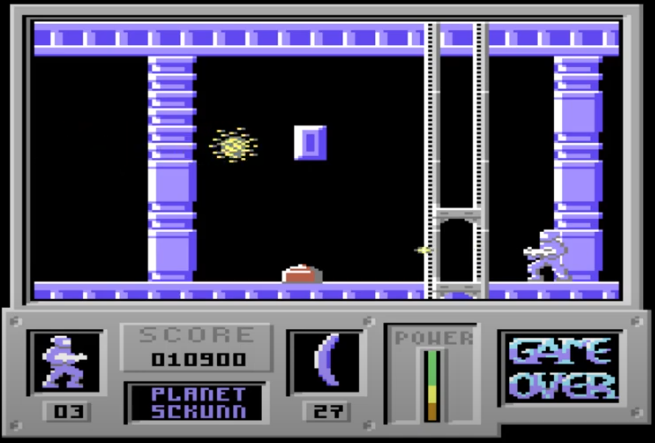
📷 More screenshots at Lemon64 and MobyGames (links below)
► THE LEGACY: MORE COVER THAN GAME, AND THAT'S NOT AN INSULT
Game Over occupies a peculiar place in the history of Spanish software. It was not Dinamic's most-played game, nor their most technically advanced. But it was one of the most recognisable, and in the eighties software market that was worth a great deal. Johanna's image became an icon of the golden age of Spanish software as naturally as the characters from Ocean or the sprites of Ultimate became icons of theirs.
Dinamic released a sequel — Game Over II, also known as Phantis — in 1988, with another spectacular Azpiri cover and somewhat more polished gameplay. But the original always had that first-love status: imperfect, excessive, and utterly irresistible to anyone who lived it at the time.
Because that was Game Over: a game that made things hard for you, had you dying constantly, came with a cover that scandalised half of Europe, and a piece of music you couldn't get out of your head. A product that was entirely a product of its time and place. Made in Madrid, for the world, with all the spark that implied.
Game Over is bigger as a cultural artefact than as a video game. Azpiri's cover, Galway's music, the censorship controversy and the Dinamic name make it an essential piece of Spanish software history, even if the game itself has its limitations. Judged purely as a shoot'em up, it's solid. Judged as an artefact of an era, it's irreplaceable. And that duality is exactly what makes it fascinating.
THE BEST
+ Iconic cover art by Alfonso Azpiri+ Soundtrack by Martin Galway
+ Two parts with different mechanics
+ Variety of planets and stages
+ Enormous historical importance
+ The censorship controversy: free marketing
THE WORST
- Unfair and frustrating difficulty- Second part more uneven than the first
- Imprecise enemy hitboxes
- No checkpoints within each part
- The cover is more memorable than the game