OUT RUN
THE TEENAGER WHO CONVERTED THE ARCADE OF THE CENTURY
► THE ARCADE THAT CHANGED EVERYTHING
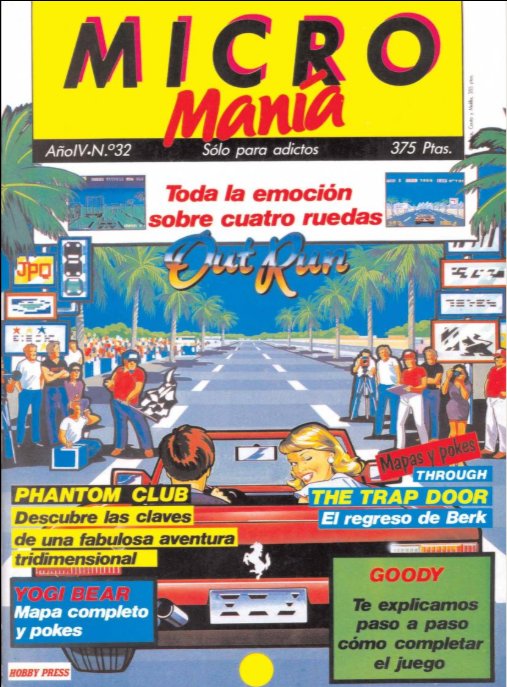
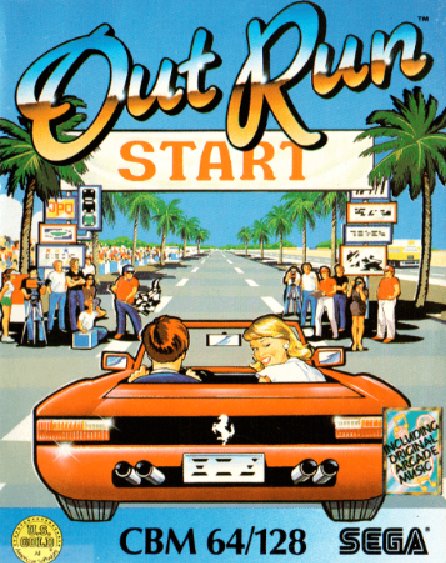
In 1986, Sega launched an arcade cabinet unlike anything seen before. Out Run wasn't a standard racing game: it was a Ferrari Testarossa convertible, a blonde girl beside you, sun, open road, and three songs that stuck in your head forever. Its creator Yu Suzuki wanted to capture the feeling of driving along the coastal roads of Europe rather than winning a competition. And he succeeded.
The arcade drained pockets without mercy. Everyone wanted a home version, and when U.S. Gold announced conversions for home computers, the anticipation was enormous. What nobody imagined was that the C64 version would end up being the work of a 17-year-old lad from Shropshire.
► THE STORY BEHIND IT: THE BOY, THE GARAGE AND THE ARCADE
Martin Webb had programmed his first games for the Texas Instruments TI-99 from home alongside his father Dennis, who handled graphics and business. When the TI-99 market dried up, Martin switched to the C64 and taught himself to program it. To find a bigger publisher, he developed a shameless Hang-On clone called Max Torque, with motorbikes instead of cars. Then, using that game's assets, he began building an Out Run clone: same perspective, same style, but with a Porsche instead of the Ferrari to avoid legal issues.
U.S. Gold took Martin into a separate room, away from his father, and there it was: a full-size Out Run arcade cabinet. Geoff Brown revealed they'd just signed a deal with Sega for the home versions. Martin's prototype was exactly what they needed. An hour later, Dennis Webb signed a contract and the team received an advance of £20,000. The clone would become the official game.
Martin took the arcade cabinet home to his garage. Without the arcade's source code or any design documentation, he recorded hours of gameplay on video and took exhaustive notes on every corner, every slope, every palm tree. The goal was for the C64 roads to feel the same as the arcade's, even if they couldn't look the same.
► THE BRANCHING ROUTES PROBLEM
One of the arcade's defining features was its branching route system: at certain points on the road you could choose between two paths, multiplying replayability. Martin tried to implement this on the C64 but the machine simply couldn't manage a multi-load system on the fly.
The solution was elegant within its constraints: instead of real-time forks, the player chooses the route before starting (A, B, C, D or E), which loads from tape or disk. Five distinct routes, each with its own scenery and corners. Not quite the same thing, but it allows variety without collapsing the hardware.
► EUROPEAN VERSION VS. AMERICAN VERSION
◄ EU VERSION (U.S. GOLD, 1987)
Simple title screen. Dark-haired passenger. No "Passing Breeze" in the music selection. Route chosen by loading each track separately. Timer runs too fast on NTSC systems (switch to PAL mode). First edition included a separate cassette with the arcade music.► US VERSION (MINDSCAPE, 1988)
Redesigned title screen with credits. Blonde passenger. Visual menu with arcade-style route map (more convenient). Engine sound added when music is off. Five modified sound effects. More detailed clouds in the background.► SCREENSHOT GALLERY
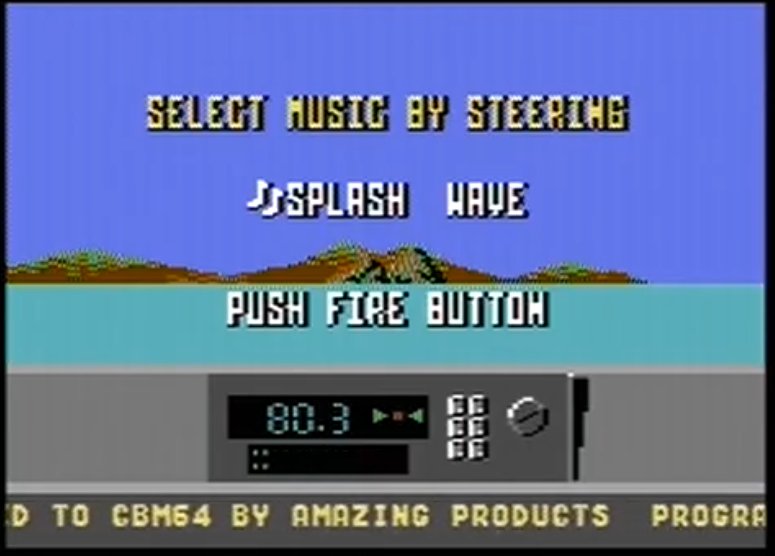
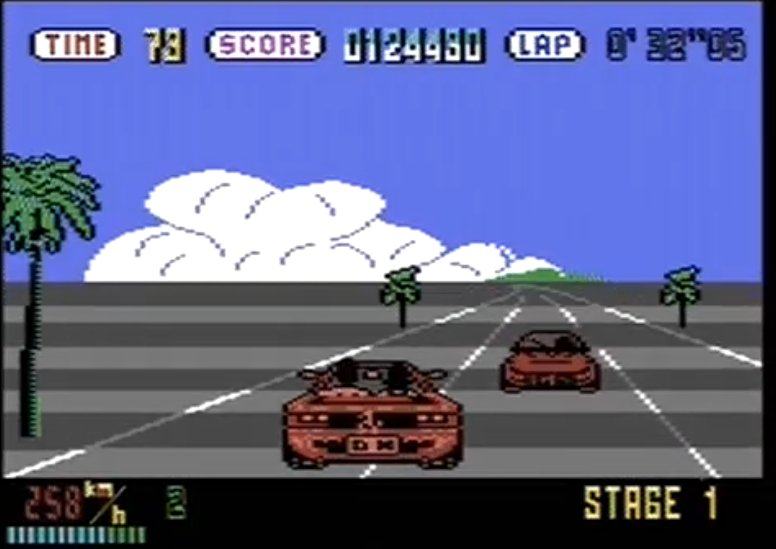
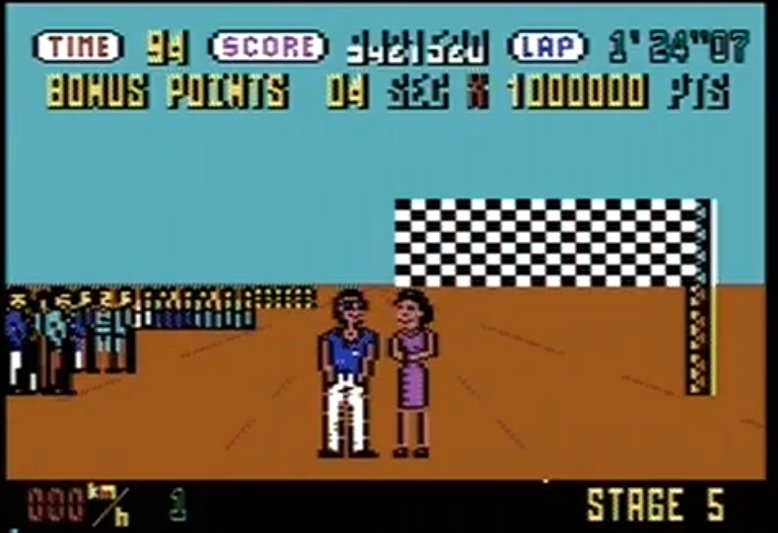
📷 See real screenshots at Lemon64 and MobyGames (links below)
► GRAPHICS: FAST, BUT PIXELATED
Compared to the arcade, the difference was abysmal — something any player of the era knew beforehand. But compared to other C64 racing games, the result was quite decent. The sense of speed was there, the scenery changed noticeably between routes, and the road curved with enough fluidity for the experience to be enjoyable.
The rival car sprites were blocky and there was pop-in (objects appearing suddenly), but the game moved at a good pace. Martin used some optimisation tricks, such as reusing scenery assets between routes with different colour palettes, to make it seem like there was more variety than there actually was.
► SOUND: JASON BROOKE AND THE SID CHIP
This is where the C64 truly shines. Jason Brooke received an audio cassette with the arcade music recorded in a real arcade, and from that had to recreate the tracks for the SID chip. The result is extraordinary: Magical Sound Shower and Splash Wave sound brilliant on the SID, with that characteristic blend of synthesiser and melody that only Commodore's chip could deliver.
The European version didn't include Passing Breeze, the arcade's third track, for reasons that were never fully clarified since there was enough free memory to have included it. An unjustified cut that fans always lamented. The American version didn't add it either.
► GAMEPLAY: PATIENCE REWARDED
The game needed a little time to hook you. The first few minutes could disappoint anyone coming from the arcade expecting the same experience, but once you accepted the hardware's limitations, Out Run on C64 was a solid and addictive racer. The controls responded well, the corner difficulty was well calibrated, and the route system gave reasons to come back.
An important detail: in the European version, if you played on an NTSC system, the timer ran too fast and the game became unfairly difficult. The solution was to switch emulation to PAL mode — players of the era who didn't know this likely suffered more than a few frustrating sessions.
Out Run on C64 is one of those conversions that, with time, has earned the respect it didn't always receive. It wasn't the arcade, and it couldn't be. But for a 17-year-old working alone in his garage with a full-size cabinet and a video camera, the result was notable. Jason Brooke's music is remembered by everyone who heard it. And the steering wheel in your hands, the girl beside you, the open road... that, even in 8-bit pixels the size of a fist, had something.
THE BEST
+ Exceptional SID music+ Good sense of speed
+ 5 distinct routes
+ Fascinating story behind it
+ Two versions with differences
+ Honest arcade conversion
THE WORST
- No real-time branching routes- Missing "Passing Breeze"
- Very pixelated graphics
- NTSC timer issue in EU version
- Far from the original arcade
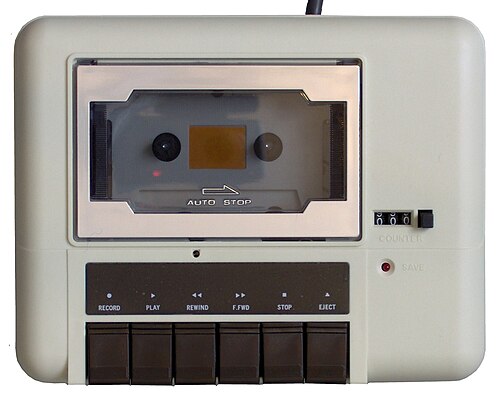
- Slow loading on cassette