ASPAR GP MASTER
SIX-TIME WORLD CHAMPION AND YOU THERE CRASHING AT RIJEKA
► THE MAN WHO WAS WINNING WORLD CHAMPIONSHIPS WHILE YOU WENT TO SCHOOL
I'm going to make a public confession: as a kid I understood nothing about motorcycles. I didn't know the difference between 125cc, 250cc and 500cc. I didn't know what the Motorcycle World Championship was or why it mattered. I knew there was a man with a helmet who appeared on television and that my father, who also knew nothing about motorcycles, would get up off the sofa when he won. That seemed enough for me to know the man was important.
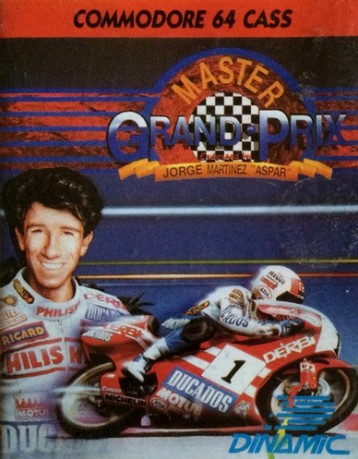
That man was Jorge Martínez Aspar. And in 1988, Dinamic Software — the same people who had caused us so much grief with Army Moves and Game Over — decided it was time to put his face on a box and sell the dream to every kid in Spain who also knew nothing about motorcycles but followed him just the same.
World Champion in 125cc in 1983, 1984, 1985 and 1988. World Champion in 250cc in 1986 and 1987. Six world titles. A national idol who at that point had more championships than most Spanish athletes combined. And there you were with your joystick.
To understand why Aspar GP Master was an event on the Spanish C64 scene in 1988, you have to understand what Aspar represented at that time. He wasn't just another rider. He was the man who had put Spain on the motorsport map at a moment when winning anything at world level was still a novelty celebrated on the evening news. When Aspar won, it led the sports bulletin. In a Spain that hadn't yet become the motorsport powerhouse it would later be, Aspar winning was genuinely remarkable.
► DINAMIC SOFTWARE: THE PEOPLE WHO MADE SPAIN'S HARDEST GAMES
If Topo Soft was the company that made sports games with a friendly face and a pretty menu, Dinamic Software was the company that put you to the test. The same people who had made you sweat blood in Army Moves, who had designed Game Over with that sadistic difficulty curve, who seemed to meet every Monday morning and ask "how do we make this even harder for the user?" It was Dinamic. And Aspar GP Master was not going to be an exception to their tradition of making your life impossible.
The difference from their earlier action games was the context: this was a motorcycle game with a real rider. A real championship. Recognisable circuits. And that changed something in the emotional equation. You weren't shooting generic enemies. You were being — or at least trying to be — the best motorcycle racer in the world. The expectations were different. The frustration when you crashed at Rijeka's third corner was different too.
► THE MENU THAT ALREADY WARNED YOU WHAT WAS COMING
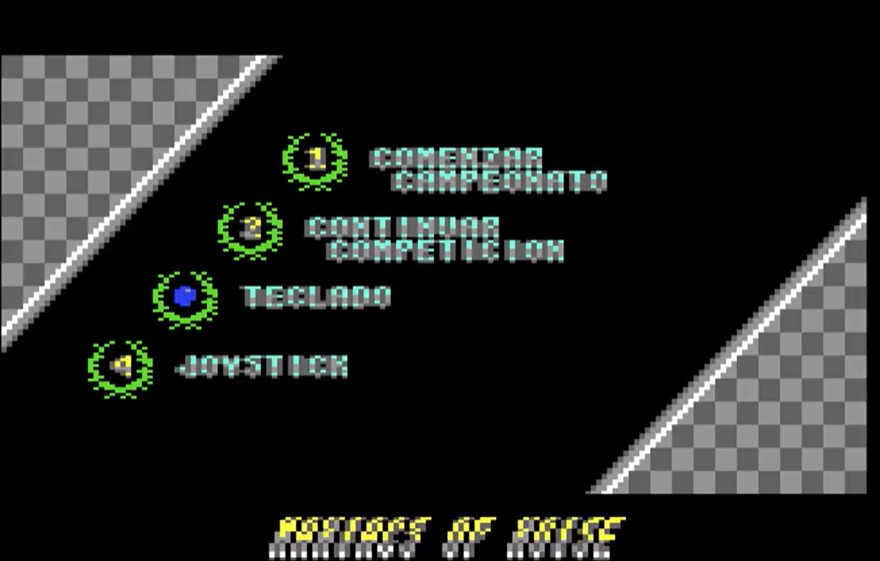
The game greeted you with a menu that had all of Dinamic's personality: black background, vivid coloured text, clear options. Start Championship, Continue Race, Keyboard, Joystick. Four options. No unnecessary decoration. No tutorials. Not the slightest interest in explaining anything to you. The philosophy was Dinamic's as ever: either you get it or you get it. And there in the background of the menu screen, Aspar's name appeared in golden letters — as if to remind you that you were about to attempt to emulate someone who had six world titles to his name.
Joystick or keyboard? This question divided the class into two irreconcilable camps. The joystick side said it was more natural, that you took corners better, that the control was more fluid. The keyboard side said they were more precise, that they had more control under braking, that we didn't know what we were doing. The truth was that with both options you fell off on the first circuit. But the argument was passionate.
► SCREENSHOT GALLERY
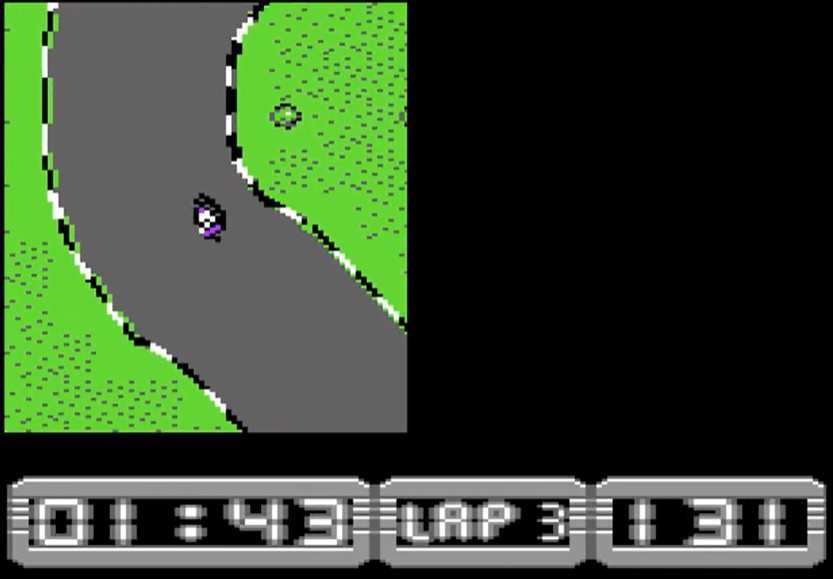
📷 The aerial view made it look simple. The joystick taught you it wasn't. The stopwatch confirmed it with mathematical coldness.
► THE AERIAL VIEW: WHEN THE C64 LOOKED DOWN AT YOU WITH MILD SUPERIORITY
Aspar GP Master opted for the aerial perspective — that top-down view that showed the bike as a tiny dot on the tarmac. It was a sensible technical decision for 1988: there wasn't enough hardware to do first-person racing at decent speeds, and the top-down view let you see the whole circuit, anticipate corners, plan your lines. In theory.
In practice, what you did was charge flat out towards the next corner praying the joystick would respond at exactly the right moment. The bike handled with a physics model that might be called "interpretive": brake too late and you were off the track, brake too early and you were stranded at the corner exit, and in the precise sliver of time between those two things lay the difference between a decent lap time and restarting the race cursing Dinamic, Aspar, joysticks in general and computers in particular.
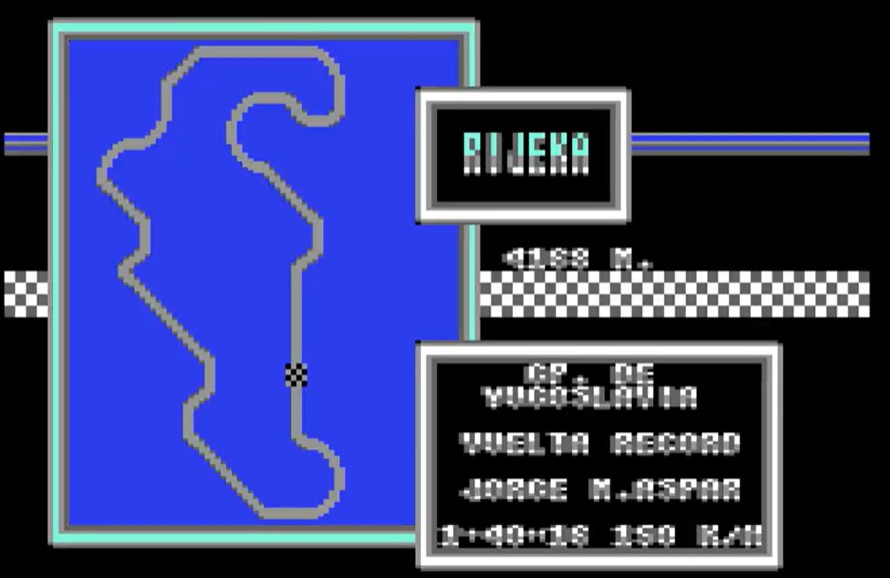
What the game did get right was the circuit design. Each track had its own personality, different lengths, corners of different radii. Rijeka with its 4,168 metres and tortuous layout. The Yugoslav GP with Aspar's lap record printed in the circuit selection screen data — a permanent reminder of how far you were from being him. The circuits had names, measurements, context. They weren't generic tracks. They were the real World Championship circuits. And in 1988, that detail mattered.
► THE CHAMPIONSHIP: BECAUSE ONE RACE WAS NEVER ENOUGH
One of Aspar GP Master's undisputed strengths was its championship mode. They didn't give you a single one-off race to pass the time. They gave you a full season, with different circuits, with a standings table to maintain, with the accumulated pressure that a retirement could cost you the title. It was an ambitious structure for 1988, and Dinamic executed it with the seriousness it deserved.
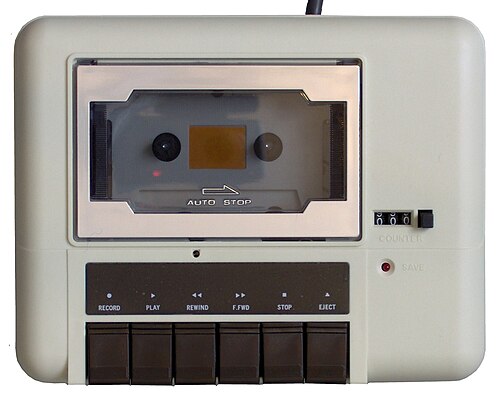
You could save your progress with the "Continue Race" option — which in the era of cassettes and endless loading times was almost a luxury. You didn't have to start the championship from scratch every time your mother called you for dinner. You could pick it up again. That sounds obvious today, but in 1988 it was a convenience not every game offered, and it made the difference between a game you finished and one you abandoned at the first circuit.
There was something hypnotic about the circuit selection screen with its track layout map, the Grand Prix name, the distance in metres and Aspar's name as holder of the lap record. Every race began with that small story: the circuit, the data, and the impossible reference to beat. It was sports narrative in 8 bits. And it worked.
► THE BIKE PHYSICS: A PHILOSOPHICAL MATTER
I'll be direct: controlling the bike in Aspar GP Master was an experience that required patience, practice and a state of mind that not every ten-year-old had at six o'clock on a Tuesday afternoon. The bike didn't move the way you wanted. The bike moved as it saw fit, taking into account your input, the game's physics, the state of the circuit and, I suspect, certain design decisions from Dinamic that seemed reasonable in 1988.
The corners were the central issue. To take a corner well you needed to brake before entry, control your line through the apex, and accelerate at the exit. Exactly what a real rider does. The problem is that Aspar took years to learn that in reality, and you had twenty minutes before your brother arrived wanting the television. The learning curve was steep. Literally — on some circuit screens, the corners were so tight that steep was the exact word.
Was this a flaw? In part, yes. But it was also what meant that when you completed a clean lap without leaving the track once, the satisfaction was proportional to the time invested in achieving it. Dinamic gave you nothing for free. And when something isn't given to you, you value it more. Basic economic principle applied to eighties video games.
► THE SID IN THE PADDOCK: THE MUSIC THAT PUT EVERYONE IN RACE MODE
The soundtrack of Aspar GP Master — which you can hear above, if you're one of those people who reads before pressing play — is one of those C64 SID chip compositions that manages to inject tension and adrenaline with minimum resources. It has that accelerated quality, that race-start energy, that rhythm which unconsciously made you grip the joystick a little tighter.
It was paddock music. Not podium music, but paddock: before the race, engine warm, nerves on edge. The SID in its element, doing with four voices what today would require a session orchestra and a five-figure production budget. Put it on. Seriously. If you're old enough to remember the eighties, that melody is going to take you straight back to a Saturday afternoon in 1988 when everything was still ahead of you.
► ASPAR IN THE EIGHTIES: THE IDOL NOBODY SAW COMING
There's something here that goes beyond the game. To understand why Aspar GP Master had an emotional impact that transcended its technical merits, you have to understand what Jorge Martínez Aspar was in 1980s Spain.
Aspar was from Algemesí, Valencia. A village kid who with a 125cc motorcycle had become the best motorcycle racer in the world. Not once. Not twice. Four times in 125cc and twice in 250cc. In a sport where Spaniards had no winning tradition, where Italians, Germans and British riders had shared the titles for decades. Aspar arrived and sent them all home. On a Derbi. With the Ducados tobacco colours on his leathers. With that smile of a normal village lad who didn't seem to belong to the world of great champions.
And that is exactly what made him so beloved. He wasn't an untouchable elite sportsman. He was the boy from the village who turned out to be the best in the world. In the eighties, that was a revolutionary concept in Spanish sport. Before Induráin, before Contador, before Spain became a motorsport powerhouse, there was Aspar winning world championships at a time when that seemed impossible for a Spanish rider.
In 1988, the year the game came out, Aspar won his fourth 125cc world title. He was the most decorated rider in world motorcycle racing in the smaller classes. And there you were, trying to complete a clean lap at Rijeka. There's something poetic in that distance.
► A GOOD GAME OR SIMPLY ASPAR'S GAME?
Here comes the moment of truth. Aspar GP Master was technically a competent game with high difficulty, a solid championship mode for the era and a presentation that did justice to the rider whose licence it carried. It wasn't the best motorcycle game on the C64 in purely playable terms — Kikstart by Mastertronic had more intuitive controls — but it had something no foreign game could offer: it was Aspar's game. And Aspar was ours.
In that late-eighties Spain, where motorsport role models were scarce and domestically produced games even scarcer, Dinamic Software made something more than a motorcycle video game. They made an interactive tribute to the greatest Spanish rider in history up to that point. And that carried a weight that can't be measured in hours of playtime or AI quality ratings.
I remember perfectly the first time I saw the box in a shop. The photo of Aspar on his Derbi, the Dinamic logo, the legend "Commodore 64 Cass". I didn't need to know if the game was good. I needed to have it. And when you had it, when it loaded and that SID music played and you saw the Rijeka map with Aspar's record printed on screen, you understood exactly what it was all about. About being — even if only for ten minutes on a weekday afternoon — the best motorcycle racer in the world.
Aspar GP Master is one of those games you need to judge with Aspar's 1988 stature in mind. Not today's Aspar — the team director — but the Aspar of then: the rider from Algemesí who had won six world championships while you went to school. Dinamic did what they did best: a demanding, austere game with no concessions. The bike physics demanded patience. The championship demanded dedication. The difficulty demanded that you crash many times before learning. But when you learned, when you completed a clean lap, when the SID music carried you through Rijeka's corners at exactly the right speed, there was something that felt very much like understanding why Aspar kept climbing back on that bike season after season. Not because it was easy. But because when it went right, there was nothing better in the world.
THE BEST
+ Aspar's face on the cover (priceless historical value)+ Complete, functional championship mode for 1988
+ Real circuits with real World Championship data
+ SID soundtrack with energy and personality
+ Dinamic at their best: austere and effective
+ The satisfaction of a clean lap was enormous
THE WORST
- The learning curve defeated the less patient- Bike physics were "interpretive"
- Kikstart had more intuitive controls
- No track map during the race
- The rival AI was predictable once you knew it