COBRA
THE TIE-IN THAT SOLD A MILLION AND WAS WORTH TUPPENCE
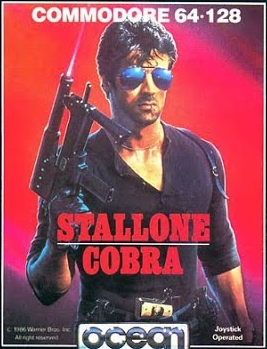
► STALLONE IN THE COMPUTER SHOP
August 1986. Cobra has been in cinemas for weeks and Sylvester Stallone is at the peak of his global fame. Rocky, Rambo, and now Lieutenant Cobretti with his mirrored shades and his shotgun. The man was a money-making machine and the studios knew it perfectly. So when Ocean Software announced the official game for the C64, Spectrum and Amstrad, the outcome was predictable before a single line of code had been written: it was going to sell like hot cakes. And it did. Sadly for the buyers, the key word in that sentence is "hot cakes".
Because Cobra, the game, is one of those textbook cases where the licence is worth infinitely more than the product. The box had Stallone's mean mug and his sawn-off Mossberg. That was enough. The newsagent, the market stall, the department store — it didn't matter where you bought it. If it said Cobra and had Rocky's face on it, you went straight to the till.
"Crime is a disease. He's the cure." promised the film's tagline. The game, on the other hand, was the disease. And the cure was switching it off after five minutes.
► OCEAN AND THE ART OF SELLING LICENSED SMOKE
Ocean Software was in the 1980s the undisputed queen of movie tie-ins. Top Gun, Rambo, Batman, RoboCop... the Manchester company had an extraordinary nose for buying licences at exactly the right moment and getting the game out while the film was still in cinemas. Quality was another matter. Ocean mastered the art of producing spectacular boxes with film stills, decent music and gameplay that ranged from mediocre to outright unplayable.
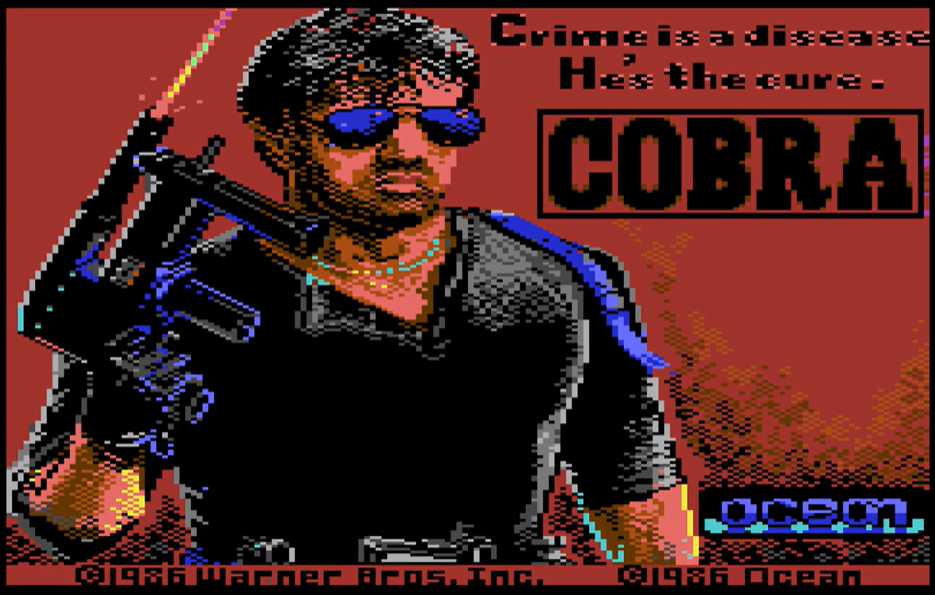
With Cobra they hit rock bottom. The game is a side-scrolling platformer where you control Cobretti through urban environments packed with enemies. The loading screen is quite the statement of intent: Stallone in reddish pixels with the legend "Crime is a disease. He's the cure." All very promising. Then the game starts and the magic evaporates faster than your pocket money.
► SCREENSHOT GALLERY
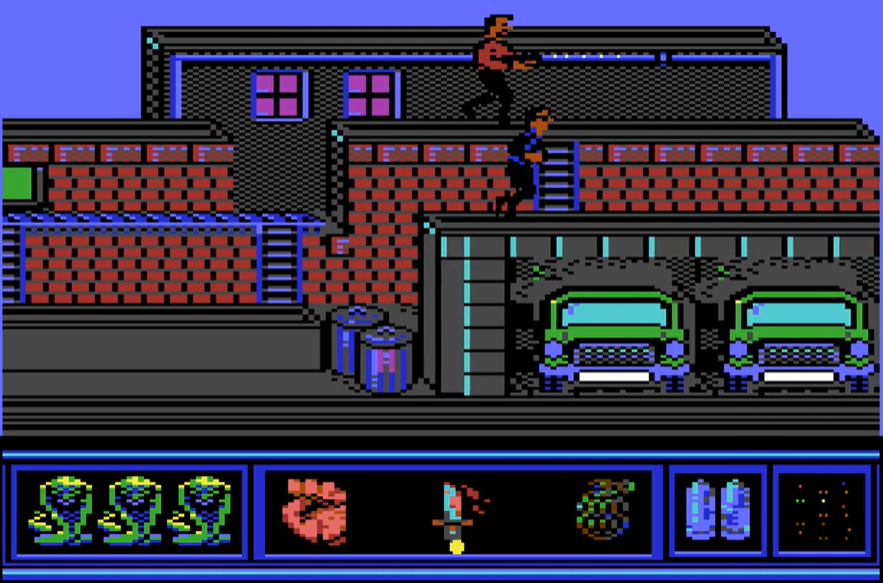
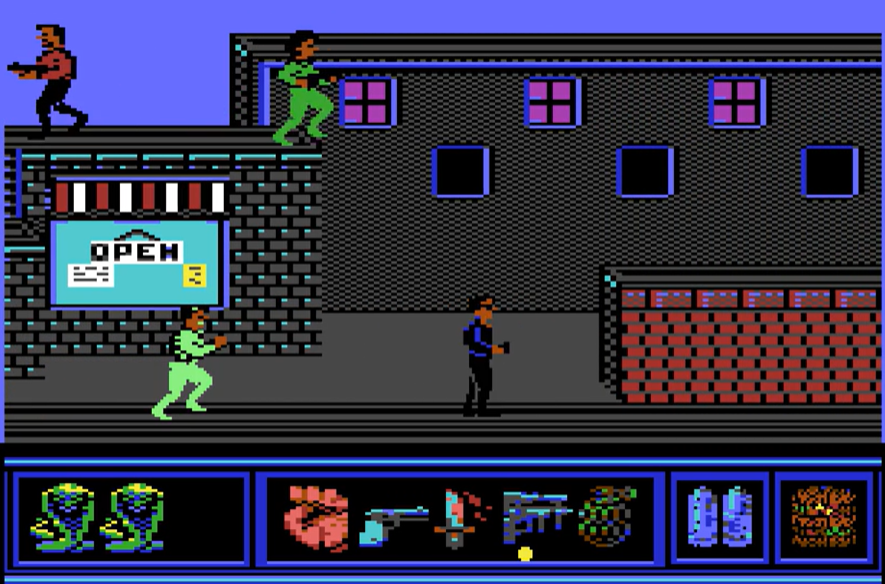
📷 Yes, the enemies are dressed in fluorescent green. No, it makes no sense whatsoever.
► GAMEPLAY: A DISASTER IN A TIE
Here lies Cobra's central problem: the game doesn't know what it wants to be. A shoot-'em-up? A platformer? An action adventure? The correct answer is "none of the above, but a bit of everything wrong with each genre". Cobretti moves through the levels with the agility of a removal lorry, enemies appear in waves with no logical pattern, and the shooting system has the accuracy of throwing a stone with your eyes shut.
The enemies deserve special mention. It turns out the villain's henchmen on the C64 are fellows in fluorescent green leotards who leap between rooftops as if they'd confused the game with Ninja Gaiden. In the Stallone film there were no green ninjas. In any Stallone film there have never been green ninjas. But here they are, in abundance. Ocean decided that staying faithful to the source material was entirely optional.
The inventory menu at the bottom of the screen shows a selection of objects and weapons that Cobretti can use. The problem is that the game never explains how to use them, when to use them, or what most of them are for. Many players of the era completed the game — the three or four who actually reached the end — without ever having touched the inventory once. It was decorative. Just like the plot.
► WHAT DOES WORK: THE LOADING SCREEN
Let's be fair. There is one thing in Cobra that deserves a genuine round of applause: the loading screen. The portrait of Stallone in reddish tones against a dark background with the film's tagline is genuinely impressive by C64 standards in 1986. Someone at Ocean really put their heart into that pixel art, with dedication and real talent. It's a shame they burned all the team's artistic energy on four seconds of loading screen and had so little left over for the actual game.
The music isn't entirely bad either — it has that 1980s action flavour that suits the film, although it becomes repetitive very quickly. But compared to what the rest of the game has to offer, the music sounds like a Beethoven symphony.
► THE LICENCE BUSINESS: HOW TO EMPTY YOUR POCKETS
The Cobra case is a perfect example of how the software market worked in the 1980s. Ocean bought the licence for a blockbuster film, designed a box with real photos from the movie, and Stallone's name did the rest. Kids at the newsagent's didn't ask if the game was good — they asked if it had Sylvester in it. And if the answer was yes, money changed hands.
This worked especially well because the flow of information about game quality was almost non-existent. A magazine might publish a review, but by the time you read it you'd already bought the game, played it, and were crying in your room. Word of mouth took weeks to spread. Ocean had already been paid.
Cobra was a massive commercial success. It sold tens of thousands of copies. Ocean bought itself a metaphorical yacht. Young players learned a valuable lesson about the world: a great cover does not guarantee a great game. Some of us took longer to learn that than others.
► IS IT WORTH IT TODAY?
Only for the historical value and the nostalgia of the grievance. If you're one of those who bought Cobra as a child with their savings and suffered the disappointment first-hand, loading it in an emulator today has a cathartic quality: confirmation that no, it wasn't you who couldn't play properly. It was the game that was bad. Objectively, irredeemably bad.
As a period document it is fascinating: it perfectly represents the golden age of shameless licensed software, when the name on the box was worth more than all the code inside. And the loading screen is still beautiful. Nobody can take that away from you.
Cobra is the perfect example of everything that could go wrong in the golden age of movie licences. Ocean bought Stallone's name, designed a spectacular box, and then delivered a game that would have embarrassed Lieutenant Cobretti himself. The loading screen is gorgeous, the music passes the time, and everything else is a parade of questionable design decisions starring fluorescent green ninjas that nobody asked for. Buy it only if you want to remember why you learned to read reviews before spending your pocket money.
THE BEST
+ Spectacular loading screen+ The music is passable
+ The Stallone cover art is cool
+ Works as a historical document
+ Teaches you to distrust licensed games
THE WORST
- Clumsy, imprecise controls- Green ninjas that have nothing to do with the film
- Useless inventory with no explanation
- Unfair difficulty due to poor design
- The licence is worth 10x more than the game
- That pocket money is never coming back