PACO MENÉNDEZ
THE MAN WHO PROGRAMMED A MONASTERY IN 8 BITS
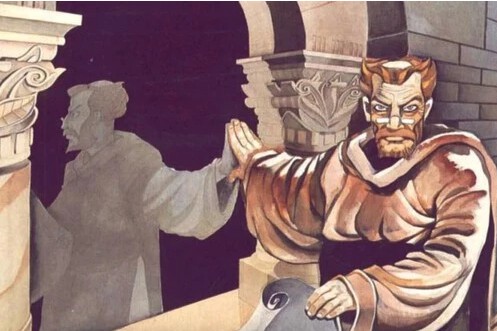
There are names that the history of Spanish video games remembers with fondness. And there is one that it remembers with something harder to define. Something between admiration, sadness, and that uncomfortable feeling that we collectively let him down without realising it.
That name is Paco Menéndez.
If you grew up with a Spectrum, an Amstrad or an MSX in the 80s, you may have spent hours inside a medieval monastery trying to solve murders while a bell pursued you like a sentence. If so, you already know who I'm talking about. If not, sit down. This deserves your attention.
Paco was born in Avilés but grew up in Madrid, and by the age of eighteen he had already published his first game. Eighteen years old. While most of us were struggling to understand the chain rule, he was releasing Fred with his university classmates. A success. A promising start. A statement of intent.
But what set Paco apart from the rest wasn't his precocity. It was his mindset. He said it himself, bluntly: he thought more like an engineer than a computer scientist. He wasn't interested in tricks, shortcuts, or just enough code to make the screen look pretty. He was interested in architecture. In systems. In making things work properly on the inside even if nobody would ever see it.
In 1986, Sir Fred arrived and the Spanish industry was left speechless. It wasn't a normal platformer. It had physics. It had inertia. The character didn't jump like a block — he jumped like something with weight, that falls, that obeys laws. On a ZX Spectrum. With a Z80 processor. In 8 bits.
What Paco did there was, technically speaking, outrageous. British company Microgen bought the rights to distribute it in the UK, which at the time was something that practically never happened with Spanish games. A British studio looking towards Spain and saying "we want this" was the equivalent of winning the Champions League as Avilés FC.
In 1987, alongside his friend Juan Delcán — who studied architecture and designed every room to be genuinely coherent — Paco locked himself away to create what remains to this day the most important work in Spanish 8-bit gaming. La Abadía del Crimen. An unofficial adaptation of Umberto Eco's The Name of the Rose. Umberto Eco, incidentally, never gave permission to use the novel's title. But that's another story.
Fourteen months. No graphics engine. No modern tools. Much of the work was resolved on graph paper before touching the keyboard. Paco would build the entire system in his head, verify it mentally, and only then commit it to code. Delcán described watching him program as being in front of a piano virtuoso.
The result was something that in 1987 should not have existed. A monastery that ran like clockwork. Monks with their own routines — eating, praying, sleeping — independently of whatever you were doing. A world that existed by itself even when nobody was looking at it.
Paco made you be a monk before you could be a detective. Nobody had done anything like it before. And in 8 bits, nobody ever did it again.
La Abadía del Crimen was a commercial failure. Not a spectacular one, not the kind that gets talked about in the press. It simply drifted past the sales charts without making a ripple. It was too dense. Too demanding. It explained nothing to the player — it dropped you in the middle of the monastery and wished you luck. Thousands of people ended up with notebooks full of hand-drawn maps and timetables.
Although by then, Paco had already walked out the door.
In the early 90s, the ground disappeared beneath the feet of an entire generation. 16-bit machines, Japanese consoles, powerful PCs. Suddenly you needed a team of fifty people and a million-pound budget to compete. Dinamic, Topo, Opera Soft. One by one, the companies of the Golden Age began to falter.
Paco could see it coming and didn't like what he saw. He summed it up himself with brutal clarity: the industry only wanted better graphics and more speed, but less thinking. He didn't want to make products. He wanted to solve problems. And video games had stopped being a technical challenge and become a business.
What came next is the most fascinating and most painful part of the story. Paco didn't give up. He simply changed battlefield.
He became obsessed with a project he called Paloma. Parallel Logic Machine. An architecture capable of housing up to 65,535 processors working in parallel. He was designing, alone in his room and with almost no resources, what we now recognise as distributed computing. The foundations of what we now call modern artificial intelligence. In the 1990s. Before anyone used those words together in a normal sentence.
Investors didn't understand. Experts looked on with scepticism. And Paco was left alone with his papers and his prototypes that nobody wanted to fund. The project that should have changed global computing remained trapped on paper.
1999
He was 34 years old.
WHO RAN OUT OF MATERIALS.
La Abadía del Crimen exists. It's still there. You can play it today and it is still extraordinary. Still difficult, still demanding, still a universe that runs by itself even when nobody is watching it. Exactly as Paco intended.
That is what remains of him. And it is enough.
This post was born thanks to a video discovered on YouTube, from the channel Cojos FC. Albert, its creator, has dedicated to Paco the tribute he deserves — a piece well worth watching if this article has caught your attention. Thank you, Albert. For rescuing the stories that deserve not to be lost.
► WATCH ON YOUTUBE