FREDDY HARDEST
THE TOUGHEST HERO TO COME OUT OF MADRID
► THE STORY BEHIND THE GAME
In 1987 Spain was not exactly the world capital of video games, but in a flat in Madrid, brothers Pablo and Víctor Ruiz were proving that you could compete with the best. Dinamic Software had already been on the market for several years, but with Freddy Hardest they made a qualitative leap that surprised everyone: an action game with two completely different parts, a charismatic protagonist and a production that came close to what the leading British studios were doing.
The character of Freddy Hardest was deliberately laddish: a tough guy, sunglasses on, stranded on alien planets with apparent indifference to his own survival. He was Spain's answer to the Anglo-Saxon protagonists of the era, and it worked. Freddy became one of the most recognisable characters in Spanish software.
Freddy Hardest was one of the first Spanish games to sell massively outside Spain, reaching the UK market through English distributors. Dinamic was beginning to stop being a local phenomenon.
► SCREENSHOT GALLERY
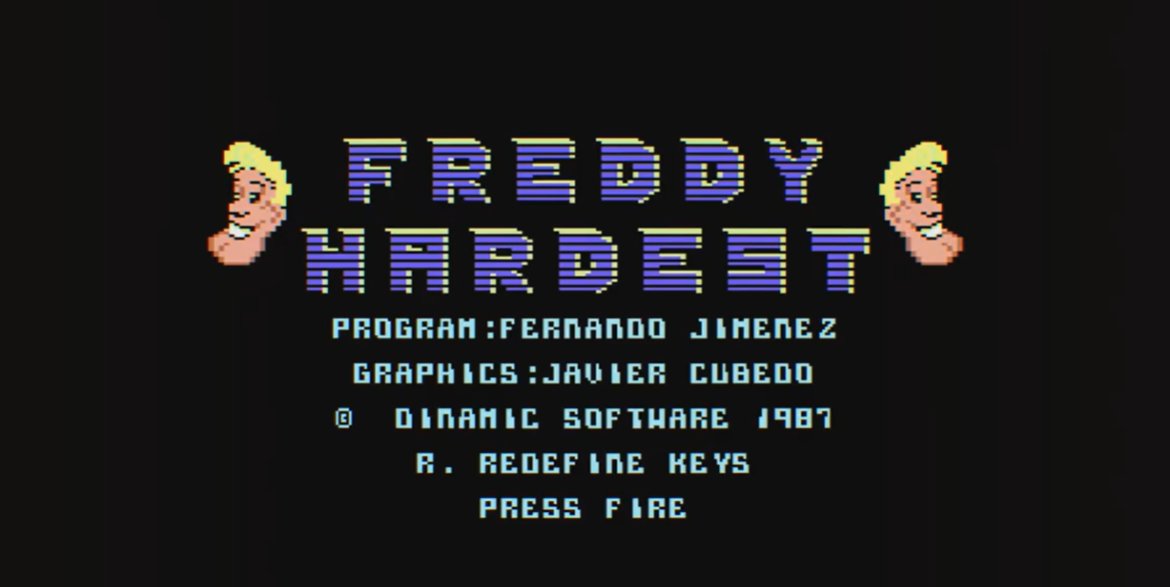
📷 See more screenshots at Lemon64 and MobyGames (links below)
► GAMEPLAY: TWO GAMES IN ONE
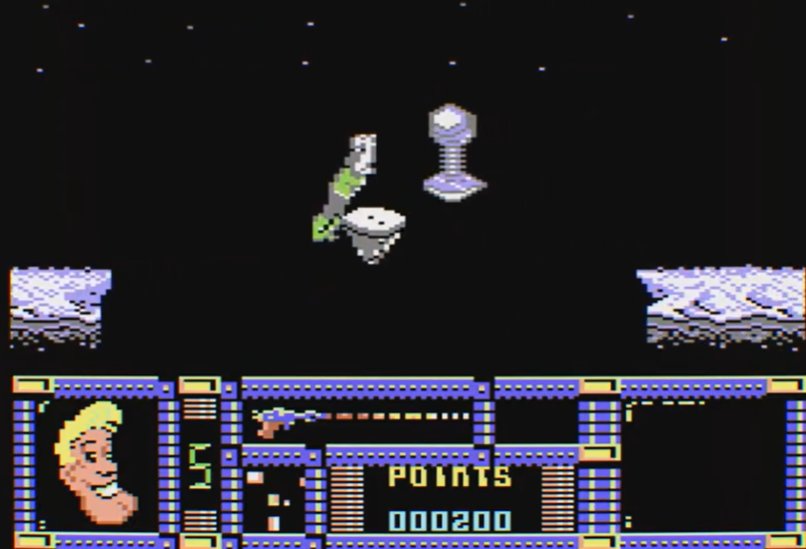
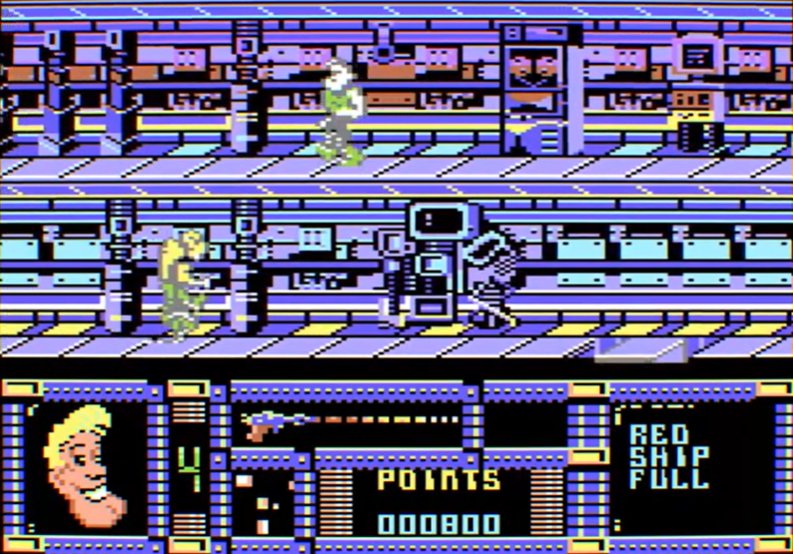
Dinamic's boldest decision was to structure Freddy Hardest in two completely different parts. The first put you in command of a spaceship in a side-scrolling shooter, dodging and firing through space packed with enemies. The second changed register entirely: Freddy landed on planet Mhyrba and the game became a platformer where you had to reach a rescue ship while navigating alien creatures and terrain traps.
This duality was both its greatest virtue and its greatest risk. If one of the two parts didn't win you over, the game lost a great deal of its appeal. But if both hooked you — and in general they did — you had an experience that offered more variety than most games of the era for the same price.
The joystick control was clean and responsive, something you couldn't always say of Spanish software of the time. Dinamic had learned from earlier mistakes and the team's maturity showed here.
► GRAPHICS: NATIONAL PRIDE
For a Spanish production from 1987, Freddy Hardest's graphics were notably good. The main character was well animated, the alien planet stages had their own personality, and the space phase used the contrast of black space against coloured sprites effectively.
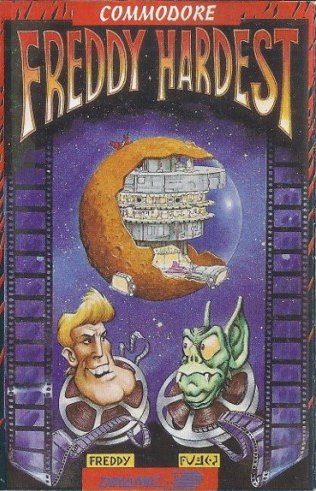
The most striking element was the presentation screen: an illustration of Freddy with his sunglasses that was visually arresting by the standards of the moment. Dinamic always paid great attention to the art on their covers and title screens, and here was no exception. When the game loaded and that image appeared, you knew you were about to play something with a degree of ambition.
► SOUND: THE SID IN SERVICE OF MHYRBA
Freddy Hardest's soundtrack made good use of the Commodore 64's SID chip. The main theme had that cadence somewhere between martial and spatial that fitted the game's theme perfectly, and the sound effects — shots, jumps, impacts — were punchy without becoming irritating after hours of play.
Compared to the Spectrum version, which sounded like the Spectrum sounded, the C64 version was clearly superior in audio. It was one of those cases where Commodore's hardware shone and you felt the difference.
► DINAMIC AND THE SPANISH CONTEXT
To understand Freddy Hardest you have to understand what Dinamic was in 1987. They were not a large studio with dozens of employees. They were a small team in Madrid operating with limited resources but with ambition disproportionate to their size. Freddy Hardest was the proof that they could create their own universe, with their own character, their own aesthetic and their own story.
In 1980s Spain, foreign games dominated the market, but Dinamic was building a fanbase that bought their games precisely because they were Spanish, because they recognised something of their own in them. Freddy Hardest was one of the titles that contributed most to creating that identity.
Freddy Hardest is much more than an 80s action game. It is a symbol of what Spanish software was capable of when it set its mind to it. With its two distinct phases, its protagonist with character, and a production above the national average, Dinamic created something that has held up better than many of its contemporaries. It is not perfect, but it has soul — and in video games that has always been worth a great deal.
THE BEST
+ Two completely different phases+ Charismatic protagonist
+ Graphics above the Spanish average
+ Memorable soundtrack
+ National pride in every pixel
THE WORST
- Very high difficulty- Space phase feels somewhat repetitive
- Short if you master it
- No checkpoints
- Spectrum version slightly better in some graphics
